The spacetime weave
Spacetime is not an empty stage: it is a three-dimensional ocean of which we are the waves — and almost all of physics becomes a reading of it.
The animation sums up the object: the medium undulates everywhere; at the knot (green) the amplitude is confiscated — the total deficit is the mass — and the neighbours carry the missing amplitude by compensation: the violet hollow is the gravitational well. Light (gold), which never entered the rails, glides over the weave without ever weighing.
The idea in one sentence
Spacetime is a medium that waves; matter is that waving knotted onto itself; gravity is the bending of waves toward the regions where the waving is missing; and h, Planck's constant, is the step of their exchanges.
The same idea, unfolded in three steps
Matter. We are not placed on spacetime as on a stage — we are woven of it. Every proton, every electron of a falling feather is a small packet of the medium's waving, closed into a knot. A particle is not an object placed in the medium: it is a fold of the medium. How that fold forms and fastens onto the medium's quiet lines — the rails — is told on the dedicated page: the rail is not a pipe, it is a line of silence that guides the waving.
Gravity. To exist, that knot confiscates some of the waving — right where the mass sits, the medium waves much less. And that shortfall does not stay put: the weave shares it outward, weaker and weaker with distance (the neighbours carry the deficit). The result: the closer you get to a mass, the less the medium waves. And a wave always bends toward the region where the medium changes — that is refraction, the same that bends light as it enters water. So the feather feels no force: its wave packet is refracted toward the Earth, where the waving is most missing. That refraction is gravity.
The quantum. Energy exchanges in this medium never proceed continuously: they advance in whole steps, the way a gear advances tooth by tooth — and each “tooth” is worth exactly h, Planck's constant. That is what we summarise by saying the weave is graduated in action.
Three facts become readings
E = hf is an identity
If the graduation of the medium is action, the energy of a wave is by definition its frequency counted in teeth. The Planck relation ceases to be a quantum postulate.
The c limit is mechanical
The meshing fixes a single propagation speed, and Lorentz kinematics is the symmetry group of the wave equation: special relativity is deduced, not posited.
Zero dispersion, structurally
Action is the only frame-free graduation: the weave is not an ether. The gamma-ray-burst nulls (EQG > 9.3 EP) are predictions of protection.
Time is the local frequency
Proper time is the count of teeth along the worldline. Near a mass the weave is depleted, the frequency drops: GPS comes out exactly (45.7 µs/day).
The reference drawing
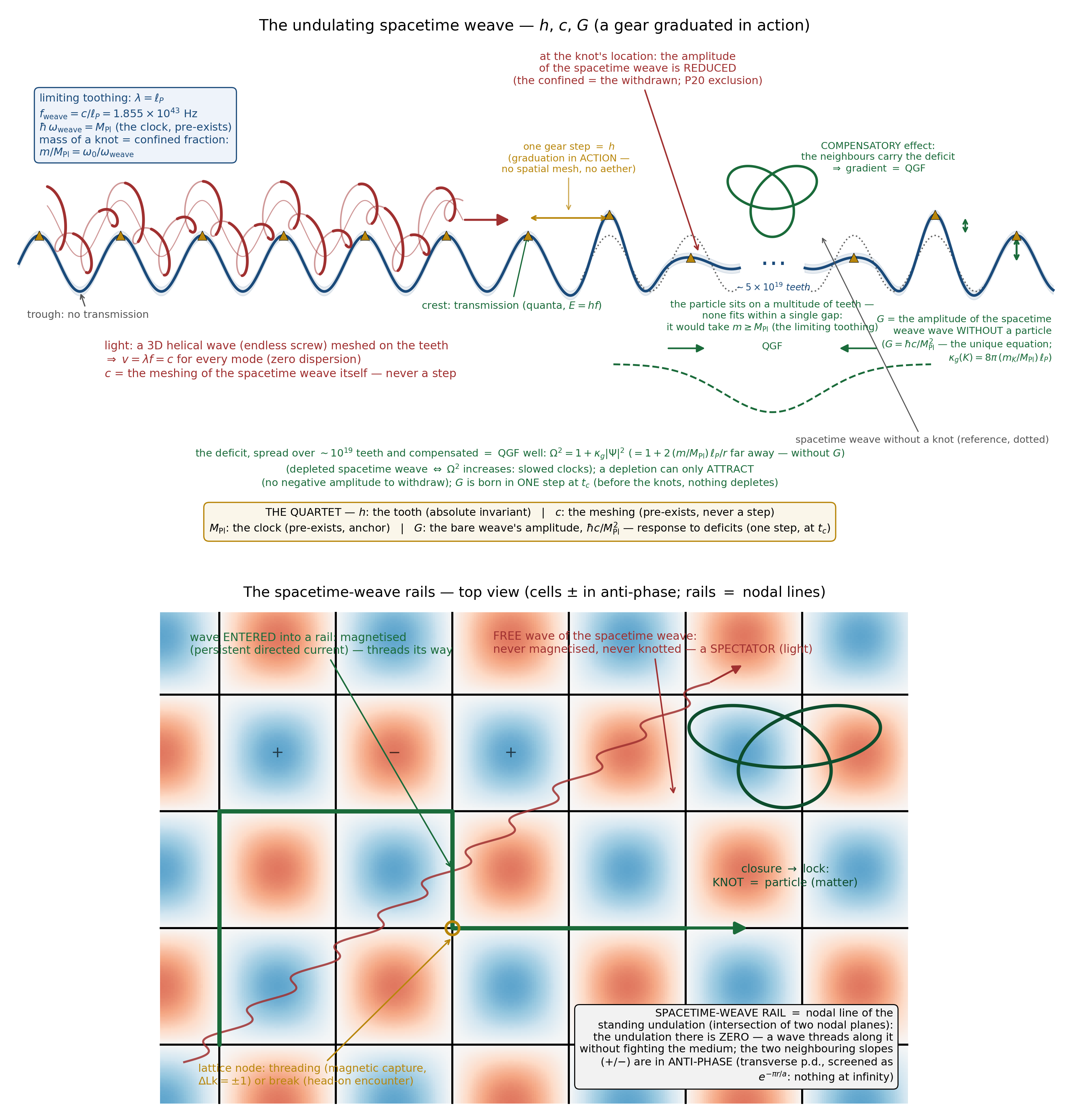
The rails: where matter is born
The nodal lines of the standing undulation form a network — the rails. A wave that enters a rail magnetizes (persistent directed current), threads through, and locks into a knot at closure: this knot is the particle. The trefoil dominates (59% of knotted closures): the universal core of matter is the most probable product of threading. Light is the population that never entered: never magnetized, never knotted, never massive — which is why the photon does not weigh.
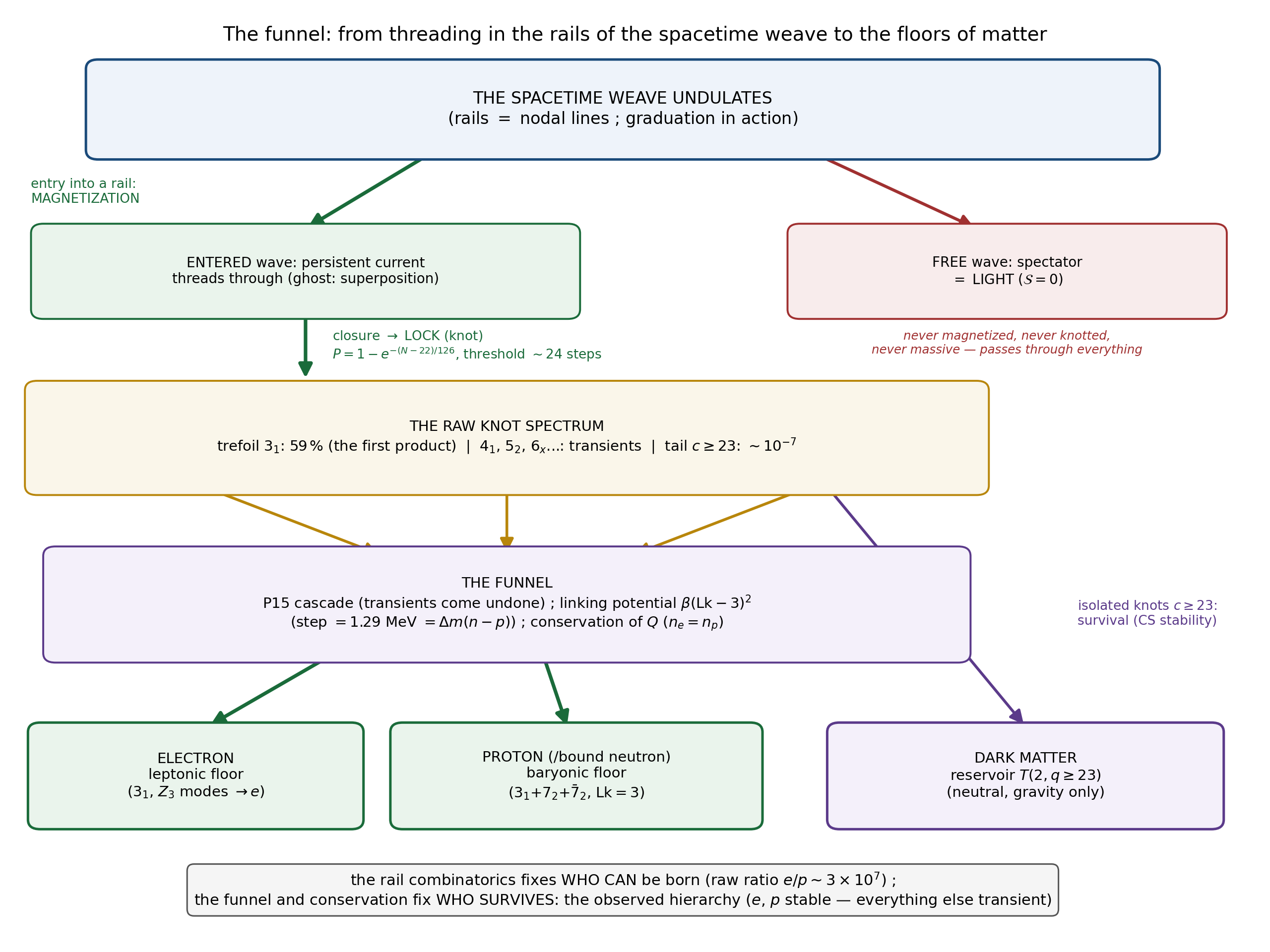
Gravitation: a depletion, a single equation
A particle extends over ~5×10¹⁹ teeth; at its location, the amplitude of the weave is strongly reduced — the confined is the withdrawn, and the total deficit is the mass. The neighbours carry the missing amplitude: the compensation gradient is the gravitational field. Gravity is weak because the weave is rich, and it only attracts (no negative mass). Its quantification fits in one equation — a unique one:
The nucleonic formula (12/7) α18 ℏc/mbase² is not a second equation: it is the reading of the rigidity MPl by the nucleon — the scale of the 18 crossings. Classical tests: Newton, Schwarzschild, Mercury, GPS exact, GW150914.
Cosmology, mechanized
✓ Five mechanizations — and one unusual theorem
- Friedmann mechanized — expansion has a cause. Matter "crushes" the weave (it confiscates its undulation); the displaced undulation pushes back, and that energy balance yields exactly Friedmann's expansion law: expansion is no longer an initial condition put in by hand — it is the weave's response to the wells dug into it. And since the push and the attraction are the same field, their balance closes exactly: Ωtot = 1 — the Universe is spatially flat on the largest scales, as a theorem. An important precision about the word "curvature": this is the global spatial curvature of the cosmos — the Ωk parameter measured in the CMB and baryon acoustic oscillations (currently +0.0023 ± 0.0016, consistent with zero) — not the local curvature around a star, which is ordinary gravitation and which the framework reproduces identically to general relativity. A firm measurement of Ωk ≠ 0 would refute.
- Scale elasticity — why the atom does not expand. The pushed weave returns wherever mass holds it: expansion only stretches what is not bound. Atoms, orbits and galaxies keep their size; only the space between independent structures expands — which is why expansion is only visible far away (the accumulated redshift), never in a ruler or an orbit.
- The river theorem — never "modified gravity". The weave responds to the mass-energy density, not to individual motions: in a galaxy in steady rotation the crushing is constant, and the weave has nothing more to say. A "nonlinear" weave that would flatten rotation curves by itself is thus forbidden by construction: flat curves require the dark reservoir — TQNT cannot fall back on a MOND, and denies itself that exit.
- Structure growth, deduced. The braking of gravitational collapse (the textbook friction term 2Hδ̇) is the weave's push: without it, matter would collapse into a single clump within a few hundred thousand years; with it, the contrast grows exactly as in ΛCDM. The amplitude of matter fluctuations (the σ8 parameter, measured at the 8 Mpc/h scale) follows: σ8 = σ8Planck, with no adjustment.
- w = −1, constant, by construction. The weave's vacuum energy neither dilutes as space expands (it is not a gas) nor withdraws (vacuum does not "leave" space): its equation of state is exactly w = −1, at all epochs. DESI's current mild preference for a varying w must therefore regress as data accumulate — were it to be confirmed, that would be a refutation.
Epistemological consequence: the observational indistinguishability from ΛCDM + GR is not an empirical finding of the framework — it is one of its theorems; and its counterpart is a register of dated absence predictions (GRB dispersion, drift of the constants, curvature, replication of the CMB anomalies, fourth family…): each falsifiable by a single contrary observation.
⚖ The honesty apparatus
- Every statement carries its status: derived, theorem, conditional, calibrated, measured.
- The framework keeps a public register of its refutations — 11 dated entries with reasons (including one mechanism refuted the very day of its consolidation): a theory is also judged by what it knows how to reject.
- Ten calibrated global parameters — and nothing per particle.
🔖 Reference
L. A. Cariou, “The spacetime weave and its consequences”, CA9 SAS, July 2026 — 25 pp, FR + EN, 18 references. Published on Zenodo: doi:10.5281/zenodo.21640710. The reference monograph remains available: doi:10.5281/zenodo.19131538. The Koide companion article is published: doi:10.5281/zenodo.20817000.