
Cahiers de physique théorique CA9
CA9 Working Papers in Theoretical Physics
ISSN pending · CA9 SAS · Brest · since 2026
The series publishes the working papers of the Research & Theoretical Studies unit of CA9 SAS, in theoretical physics: quantum theory of topological knots (TQNT), structure of the mass spectrum, cosmology of the spacetime weave, and the observational confrontations attached to them.
Contents
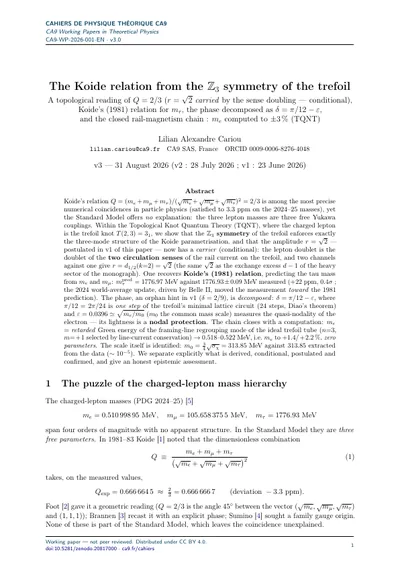
CA9-WP-2026-001 · 23 June 2026
A topological reading of the Koide relation: Z₃ structure, the √2 amplitude, and a parameter-free electron-mass estimate
Lilian Alexandre Cariou · version v3 (31 August 2026) · 6 pp.
Koide's relation Q=(m_e+m_μ+m_τ)/(√m_e+√m_μ+√m_τ)² = 2/3 is one of the most precise numerical coincidences in particle physics (3.3 ppm on the 2024-25 masses), yet the Standard Model offers no explanation. We give it a topological reading: the three charged leptons as the three Z₃ generation modes of a single trefoil knot, the √2 amplitud…
CA9-WP-2026-002 · 28 July 2026
The spacetime weave and its consequences: theorems, mechanizations, and a falsifiable register
Lilian Alexandre Cariou · version v2 (31 August 2026) · 26 pp.
The spacetime weave — a standing-wave background of a single field, graduated in action — mechanizes several pillars usually taken as postulates: E=hf as an identity, Lorentz kinematics from zero structural dispersion, the flat Friedmann law and Omega_tot=1 as a theorem, w=-1 by construction, and gravity as the weave's response to deficit…
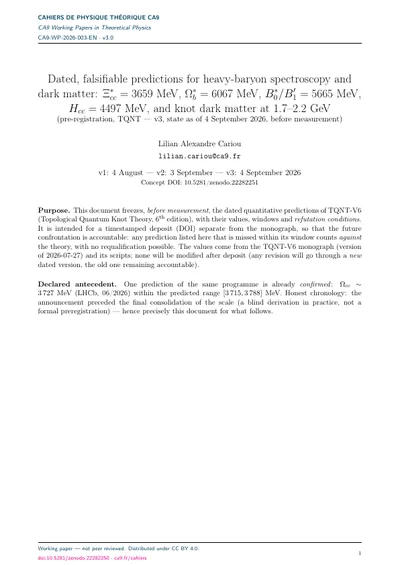
CA9-WP-2026-003 · 4 August 2026
Dated, falsifiable predictions for heavy-baryon spectroscopy and dark matter: Ξ_cc* = 3659 MeV, Ω_b* = 6067 MeV, B₀*/B₁' = 5665 MeV, H_cc = 4497 MeV, and knot dark matter at 1.7–2.2 GeV
Lilian Alexandre Cariou · version v3 (4 September 2026) · 4 pp.
This document freezes, before measurement, the dated quantitative predictions of TQNT, with their values, windows and refutation conditions. Heavy-baryon spectroscopy: Ξ_cc* = 3659 MeV (J=3/2 partner), Ω_b* = 6067 MeV, the fifth Ω_b(1P, j=0) at 6297–6304 MeV, the bottom j_K=1/2 doublet B₀*/B₁' at a centroid of 5665 MeV with a 6.6 MeV spli…
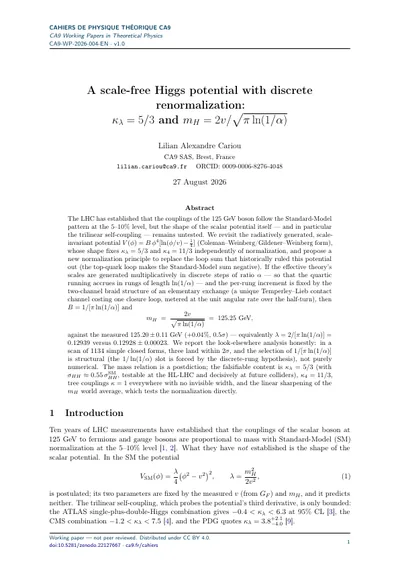
CA9-WP-2026-004 · 27 August 2026
A scale-free Higgs potential with discrete renormalization: κ_λ = 5/3 and m_H = 2v/√(π ln(1/α))
Lilian Alexandre Cariou · version v1 (27 August 2026) · 7 pp.
The LHC has established that the couplings of the 125 GeV boson follow the Standard-Model pattern at the 5-10% level, but the shape of the scalar potential — in particular the trilinear self-coupling — remains untested. We revisit the radiatively generated, scale-invariant potential with a discrete renormalization step: it predicts κ_λ = …
CA9-WP-2026-005 · 26 August 2026
From Nothing to Particles — TQNT, sixth edition: the detailed monograph
Lilian Alexandre Cariou · version v6 (4 September 2026) · 336 pp.
The Topological Knot Quantum Theory (TQNT) rests on a single principle: the vacuum is unstable, its perturbations are waves, and some of these waves close back on themselves into knots. The monograph carries the demonstration from that principle to the particle spectrum: topological invariants, the mass law m = √(sigma_chi) x S, charge as…
Editorial policy
Versions. Every revision carries a number and a date. Earlier versions remain available and citable.
Corrections. An error leads to a new version headed by an erratum, never to a silent rewrite.
Refutations. Refuted predictions are entered in the public register, on the same footing as confirmed ones.
Submitted elsewhere. A document may sit in the series and be under review at a journal: the series performs no peer review.